
Knives and Handles
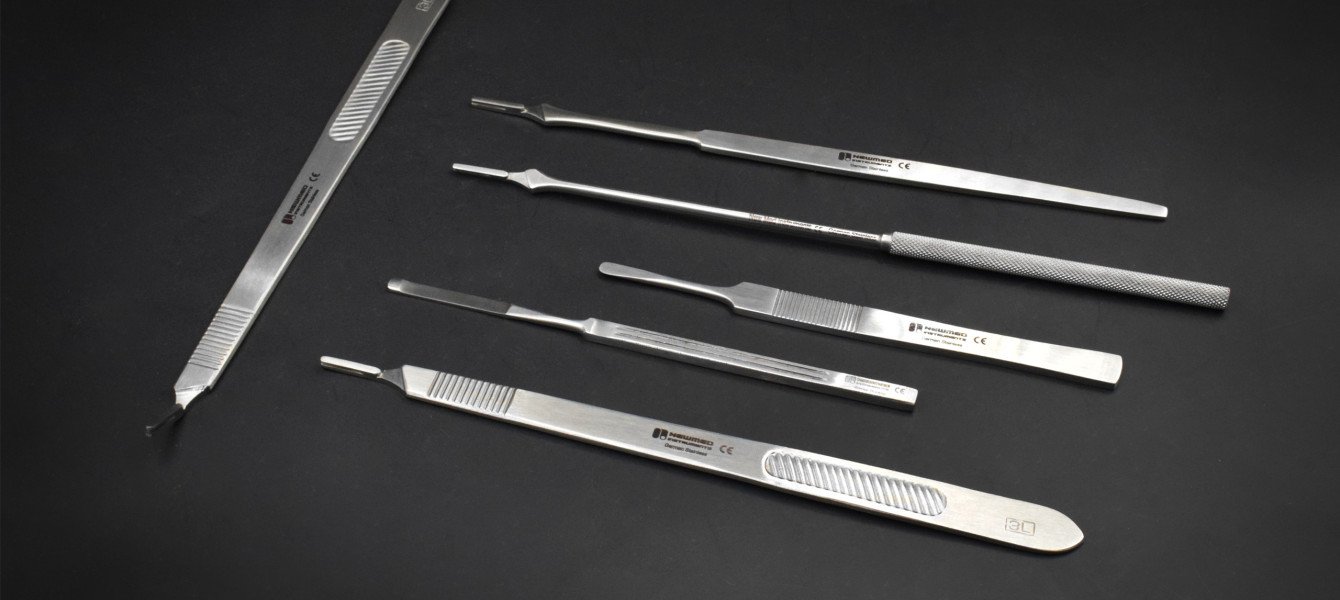
Knives and Handles | Rhinoplasty and Septoplasty tools
Knives and handles are handheld plastic surgery tools that enable incision and cutting through soft tissues and preparing cartilage in several procedures. These tools are needed for complicated plastic surgeries like rhinoplasty and septoplasty, etc.
The fragile structures need controlled cutting with care. Newmed has different types of handles, blade fittings, and specialized surgical instruments available to help surgeons select the right instruments for proper procedures and techniques.
Surgical Knives and Handles for Plastic Surgery
Each surgical operation on the nasal structure calls for a suitable cutting instrument based on the type of tissue being operated on. A scalpel handle provides control over the movement of the blade, and specially designed blades are used for different nasal procedures.
The surgical knife handle can support compatible blades, while the reliable nasal knives give better control over procedures on the septum and cartilage. NewMed supplies its system with No. 3 and No. 7 handles and the specialized nasal knives.
Knives and Handles Chart
| Instrument | Configuration | Uses |
| Round scalpel handle | Features a rounded grip designed for controlled fingertip manipulation. | Used for precision cutting where rotational handling is useful. |
| #3 scalpel handle | Features a standard small-blade fitting with a flat, balanced profile. | Used for precise skin incision and fine soft-tissue dissection. |
| #4 scalpel handle | Features a larger fitting designed for the larger scalpel blade family. | Used where a broader, heavier cutting blade is required. |
| #7 scalpel handle | Features a long, narrow profile with the small-blade fitting. | Provides fine control and additional reach in plastic and nasal surgery. |
| Septum knife | Features a dedicated cutting edge for septal tissue. | Used for septal procedures and cartilage preparation. |
| Rhinoplasty knife | Features a specialized narrow cutting profile for nasal surgery. | Used for controlled incision and dissection during rhinoplasty. |
| Ballenger swivel knife | Features a bayonet-shaped shaft and swiveling blade. | Used for controlled removal of septal cartilage during septal surgery. |
| Cottle knife | Features a specialized nasal cutting profile. | Used for controlled cutting during septal and nasal procedures. |
| Cartilage knife | Features a sharp edge suited to controlled cartilage cutting. | Used for trimming, shaping, and preparing cartilage grafts. |
| Joseph knife | Features a narrow profile for delicate nasal work. | Used for precise nasal incision and dissection. |
How to Choose Surgical Knives and Handles
- Select either a Number 3 or Number 7 handle for delicate blades, while a Number 4 handle should be utilized for large blades.
- Make the right choice of handle as per blade type.
- Prior to making a purchase, always confirm the attachment, balance, and grip of the blade.
- Pay attention to the length, as well as the dimensions and style of the handle suitable for narrow nasal cavities.
- Use a scalpel handle made of surgical-grade German stainless steel.
- Make sure to review the sizes, configurations, and customization options.
- Ordering compatible blades requires that patients check the fitting system of the scalpel handle.
Pair surgical knives and handles with more Rhinoplasty and Septoplasty tools
Knives and handles are paired with retractors, elevators, and saws, along with other nasal equipment, in the procedures of rhinoplasty and septoplasty. NewMed offers specialized instruments in rhinoplasty such as scalpel handles No. 3 and No. 7, Masing rhinoplasty knives, Cottle knives, Freer septum knives, and Ballenger swivel knives.
FAQs
Q1: #3 vs #4 scalpel handle: what is the difference?
A #3 scalpel handle is a surgical tool that uses the smaller blade fitting, and a #4 scalpel handle can fit the larger blade.
Q2: What is a swivel knife used for in septoplasty procedures?
A Ballenger swivel knife is a surgical tool that is used to cut and remove specific parts of the cartilage in a septoplasty with controlled handling.
Q3: Where can I get a scalpel handle?
To buy a scalpel handle, you can contact us!
Q4: Which blades fit a #3 scalpel handle better?
The No. 10, 11, 12, or 15 blades are common blades that fit the configuration of this scalpel handle.


Model: NM-DI-788255
Ballenger swivel knifeNewMed® Brand New Ballenger Swivel Knife is a precision surgical instrument very much in demand for its specialized application in rhinoplasty and other nasal surgeries entailing septal cartilage trimming. The swivel knife is manufactured from the finest grade stainless steel a..
$44.80 $64.00


Model: NM-DI-789440
Barron Octagonal Knife NewMed® Brand New Barron Octagonal Knife features an overall length of 5 ½” (14cm) and is used in many plastic surgery procedures. The handle's octagonal shape improves the surgeon's control during delicate surgical procedures and offers a firm, non-slip grip. It is ..
$16.80 $24.00


Model: NM-DI-786620
Blake blade holder NewMed® Brand New Blake blade holder is specifically designed to hold the Blake blade which is a curved flat blade used for dissection and excision of soft tissues. Its whole length measures 15.5 cm. During various reconstructive procedures, the angled design makes it ea..
$34.30 $49.00


Model: NM-DI-788256
Bruening septum knife NewMed® Brand New Bruening septum knife is an adjustable knife with an overall length of 16cm and a blade size of 7mm x 9mm , mainly employed in rhinoplasty and septoplasty. The adjustable blade allows the surgeon to adjust the depth and angle of the incision while wo..
$34.30 $49.00


Model: NM-DI-789442
Corwin Knife Handle NewMed® Crowin Knife Handle is designed for Brad-Parker Type Blades- sizes 10-15 common to most medical fields. It is 5 ¾" (14.5cm) in overall length and provides comfort to the hand, giving the surgeon perfect grip and control during very fine surgery. Because of the ergono..
$32.90 $47.00


Model: NM-DI-786602
Cottle Double-Edged Knife NewMed® Brand New Cottle Double-Edged Knife is a class of surgical instruments used for specific sections and dissections in rhinoplasty and other nose surgeries. The straight, double-edged blade provides clean cuts and accuracy, hence ideal for all delicate and g..
$15.40 $22.00


Model: NM-DI-786603
Cottle Nasal KnifeNewMed® Brand New Cottle Nasal Knife is a precision surgical instrument designed for use in nasal and rhinoplasty procedures. Its straight blade ensures a clean and accurate incision and helps in the delicate dissection of nasal tissues. Features overall length (14cm). Co..
$15.40 $22.00


Model: NM-DI-786601
Curved Converse RhinoplastyNewMed® Curved Converse Rhinoplasty Knife features an overall length of 15cm that offers a good balance between control and reach. During rhinoplasty procedures, it is utilized to precisely dissect soft tissues, produce soft tissue incisions, and elevate skin flaps. Smooth..
$29.40 $42.00


Model: NM-DI-786623A
Finger GoniometerNewMed® Brand New Finger Goniometer 13cm is a precision measuring device put into service for the accounting of the range of motion in either of the finger joints and is widely used by physical therapists, orthopedics, and rehabilitation specialists. Features overall length (13cm)...
$67.20 $96.00

Model: NM-DI-788259
Fomon Nasal knifeNewmed® Brand New Fomon Rhinoplasty knife has a straight or slightly curved sharp blade that provides clean cuts with minimal trauma to surrounding structures. It is employed in nose reconstruction treatments for cartilage manipulation and tissue dissection. It works ..
$32.83 $46.90


Model: NM-DI-788260
Freer Ingals submucosa knifeNewmed® Brand New Freer Ingals submucosa knife features a sharp blade and an overall length of (17cm) which is a balanced size for precise control in both shallow and deep dissection. During rhinoplasty, septoplasty, and other nasal reconstructive proc..
$47.52 $67.89


Model: NM-DI-788261
Freer septum/ mucosa knife NewMed® Brand New Freer septum/ mucosa knife is used for precise submucosal dissection and elevation of mucosal flaps during nasal reconstructive surgeries. Its entire length of (19cm) gives the surgeon exceptional leverage and accuracy while doing deli..
$48.30 $69.00


Model: NM-DI-786604
Freer Septum Mucosa KnifeNewmed® Brand New Freer Septum Mucosa Knife features a D-like shape or a slight curvature to the blade and an overall length of 16.5cm. During nasal reconstructive procedures, it is employed to harvest mucosal grafts, elevate the mucosal flaps, and dissect the nasa..
$34.65 $49.50


Model: NM-GRY-568
Halle Brain KnifeNewMed® Brand New Halle Brain Knife is used for marking incisions in the brain during different neurosurgery procedures. It features a flat hollow handle that offers excellent grip and an overall length of 8” (20cm).Crafted with Premium surgical-grade German Stainless Steel to ensur..
$34.30 $49.00


Model: NM-DI-786552
Jako Micro Laryngeal KnifeNewMed® Jako Micro Laryngeal Knife is a precise and delicate instrument for controlled cuts while performing procedures on the larynx. Its working length and overall length of 8-5/8″ (22.0 cm) and 11-5/8″ (30.0 cm) are perfect for radically cutting the laryngeal mucosa, par..
$48.30 $69.00


Model: NM-DI-786624
Jameson CaliperNewMed® Jameson Caliper Graduated in Inches and Millimeters features an overall length of 3 ¾” (10cm), measuring 80mm range. It is mostly used to measure the depth, breadth, and length of incisions that will be removed during surgery and the thickness of skin or tissue. Because o..
$61.60 $88.00


Model: NM-DI-786606
Joseph Double-Edged KnifeNewMed® Brand New Joseph Double Edged Knife 15cm is total overall length size sharp tip, curved double edge knife has a sharp cutting edge to make delicate skin and cartilage incisions rhinoplasty. It is used in rhinoplasty, septoplasty, and other nasal reconstruct..
$48.30 $69.00


Model: NM-DI-786625
Joseph Measuring RodNewMed® Brand New Joseph 17cm, Graduated in Millimeters is used for taking accurate measurements of anatomical structures, wounds, and tissues during different plastic surgery procedures. Measuring Rod During surgery, the millimeter graduations provide incredibly precise, no..
$48.30 $69.00


Model: NM-DI-786605
Joseph Nasal Button End Knife AngledNewMed® Brand New Joseph Nasal Button End Knife features an overall length of 16cm and is used in rhinoplasty and other nasal reconstructive procedures. The button end has a blunt tip that may cut or dissect soft tissue without causing damage to surrounding s..
$34.30 $49.00


Model: NM-DI-786607
Joseph Nasal KnifeNewMed® Brand New Joseph Nasal Knife features an overall length of 15cm and is used for precise dissection, incisions, and tissue manipulation within the nasal structures. Rhinoplasty, septoplasty, and other nasal reconstruction techniques employ it. The surgeons can crea..
$48.30 $69.00


Model: NM-DI-789441
Kaye Lightweight Knife HandleNewMed® Brand New Kaye Lightweight Knife Handle features an overall length of 6 1/8” (15.5cm) and is designed to hold Bard-Parker Type Blades 10-15. Surgeons can perform delicate procedures with greater control, dexterity, and less hand fatigue thanks to t..
$16.80 $24.00


Model: NM-DI-786626
Knochen Messzirkel Bone Bow SpacerNewMed® Brand New Knochen Messzirkel Bone Bow Spacer features an overall length of 19.5cm and Sharp Tips. It is frequently used in craniofacial, nasal, and facial skeleton surgery to measure and space out bone or cartilage. The sharp tips are intended to m..
$97.30 $139.00


Model: NM-DI-788262
Maltz cartilage knifeNewMed® Maltz cartilage knife with blade guard- angled 16cm is used in rhinoplasty for cutting, shaping, and trimming cartilage. During auricular reconstruction, it is used to shape and polish cartilage grafts that are utilized to restore the form of the ear. When working ..
$68.60 $98.00


Model: NM-DI-788263
Masing cartilage knife NewMed® Masing cartilage knife features a curved blade and an overall length of 13cm with 4mm width. It is used for manipulation, shaping, or excision of cartilage during rhinoplasty, otoplasty, and facial reconstruction procedures. The sharp blade has been successfully ..
$47.46 $67.80


Model: NM-DI-786550
Micro Laryngeal Knives SetNewMed® Offers Micro Laryngeal Knives, which are precision-made instruments used in various laryngeal surgeries. These versatile tools are designed to incise the laryngeal mucosa radially and are therefore very effective in airway stenosis, thus improving surgical outcomes...
$41.30 $59.00

Model: NM-DI-786547
Micro Laryngeal Knives SetNewMed® Offers Micro Laryngeal Knives, which are precision-made instruments used in various laryngeal surgeries. These versatile tools are designed to incise the laryngeal mucosa radially and are therefore very effective in airway stenosis, thus improving surgical outcomes...
$27.30 $39.00

Model: NM-DI-786551
Micro Laryngeal Knives SetNewMed® Offers Micro Laryngeal Knives, which are precision-made instruments used in various laryngeal surgeries. These versatile tools are designed to incise the laryngeal mucosa radially and are therefore very effective in airway stenosis, thus improving surgical outcomes...
$27.30 $39.00


Hot
Model: NM-DI-789416
Precision Knife HandleNewMed® Brand New Precision Knife Handle features an overall length of 5 ¼” (13cm) and is designed for BP-type (10-15) blades. The BP blades are utilized in a variety of plastic and reconstructive surgeries and are renowned for their accuracy and sharpness. The surgeo..
$18.90 $27.00


Model: NM-DI-786622
Round scalpel handleNewMed® Introducing the Round Mini Scalpel Handle, which is designed to house miniature scalpel blades that are generally used in microsurgical procedures, facial aesthetic surgeries, and every other meticulous operation. Features 15.5cm overall length. It has a compact, rou..
$9.80 $14.00


Model: NM-DI-786623
Round scalpel handleNewMed® Brand New Round scalpel handle, overall length 12.5cm or 36cm. This product is designed to work with tiny scalpel blades that are commonly used in facial aesthetic surgery, microsurgical procedures, and other delicate procedures like MICS and VATS. Its round ergonomic d..
$14.00 $20.00


Model: NM-DI-9011
Scalpel Blade Handle #4NewMed® Brand New Scalpel Blade Handle #4 is the long version which is larger than the standard handle. It is made to fit scalpel blades of various diameters (#20, #21, #22, or #23). Surgeons can operate more comfortably at deeper surgical sites thanks to its improve..
$14.00 $20.00


Model: NM-DI-786608
Scalpel Blade No-10NewMed® Brand New Scalpel Blade No-10 has a curved cutting edge that makes it ideal for incisions along curved lines or for shaping tissues. The wide, deep curve provides a larger cutting surface which makes it suitable for longer, straight incisions and for cutting tou..
$9.10 $13.00


Hot
Model: NM-DI-786609
SCALPEL HANDLE #3 STANDARDNewMed® Brand New #3 Standard Scalpel Handle is a medium-sized handle and features an overall length of 5” (13cm). Depending on the particular requirements of the treatment, it can be used with scalpel blades of different diameters (#10, #11, #12, and #15). When makin..
$14.00 $20.00


Model: NM-DI-786621
Scalpel handle #4l longNewMed® Brand New #4l Long Scalpel Handle is the long version which is larger than the standard handle. Surgeons may work comfortably in deeper surgical sites thanks to their improved control and increased reach, which are designed to fit several sizes of scalpel blades (..
$16.10 $23.00


Model: NM-DI-786613
Scalpel Handle #7NewMed® Scalpel Handle #7, Short features an overall length of 14.5cm. More accurate control over the blade is made possible by the handle's shorter length. Engineered with a slim, pen-like profile for delicate surgical procedures, the width of the neck and handle is exceptionally ..
$16.10 $23.00


Model: NM-DI-786619
Scalpel Handle Bayonet TypeNewMed® Brand New Scalpel Handle Bayonet Type features an overall length of 21cm which makes it useful for making deep incisions. Its bayonet design allows the surgeons to keep their hands out of the way while yet having a great view of the surgical site. During..
$19.60 $28.00


Model: NM-DI-786616
Scalpel Handle RoundNewMed® Scalpel Handle Round is characterized by a smooth, cylindrical shape that offers a comfortable, non-slip grip. Because it weighs less than conventional scalpel handles, it is easier to control and enables precise movements, especially in delicate areas. A range of blade ..
$19.88 $28.40


Model: NM-DI-786614
SCALPEL HANDLE #3 LONG NewMed® Brand New #3 Long Scalpel Handle features an overall length of 7” (17.5cm) which provides a longer grip as compared to the standard #3 handle. Depending on the type of incision needed, it can be used with scalpel blades of different sizes..
$20.30 $29.00


Model: NM-DI-786615
SCALPEL HANDLE, #3LA LONG ANGLEDNewMed® Brand New #3LA Long and Angled Scalpel Handle features an overall length of 7” (17.5cm). It gives surgeons extra reach and makes it possible for them to make more accurate incisions. Because it is usually inclined between 15 and 30 degrees, the surgeons c..
$16.10 $23.00


Model: NM-DI-786612
SCALPEL HANDLE #7NewMed® Brand New Handle #7 is relatively smaller and slender compared to larger handles Used by a physician for cutting or dissecting tissue. It is made for delicate work and provides an excellent mix of flexibility and control. It is perfect for creating tiny, preci..
$16.80 $24.00


Model: NM-DI-786618
Scalpel, Round HandleNewMed® Brand New Scalpel, Round Handle, Long features an overall length of 27cm which provides the surgeons with extended reach to access deeper tissues. Its ergonomically designed round handle offers a secure grip and provides comfort during prolonged surgeries. It..
$20.58 $29.40


Model: NM-DI-786560
Sickle Knife PointedNewMed® ENT Sickle Knife is a specialized surgical instrument for making delicate cuts in ENT operations. Its curved, sharp blade provides precise dissection and removal of tissues in sinus and nasal surgeries. The ENT Sickle Knife has a 190mm overall length and a 10mm curved bla..
$48.30 $69.00


Model: NM-DI-786617
Long Slim Scalpel HandleNewMed® Brand New Long Slim Scalpel Handle has a total length of 22.5 cm and provides surgeons with improved control and dexterity for accurate incisions. More access to the deeper surgical sites is made possible by it. During extended treatments, this lightweight ..
$18.20 $26.00
Showing 1 to 43 of 43 (1 Pages)