
Plastic Surgery Instruments for Clinics & Hospitals: Essential Tools You Need to Know
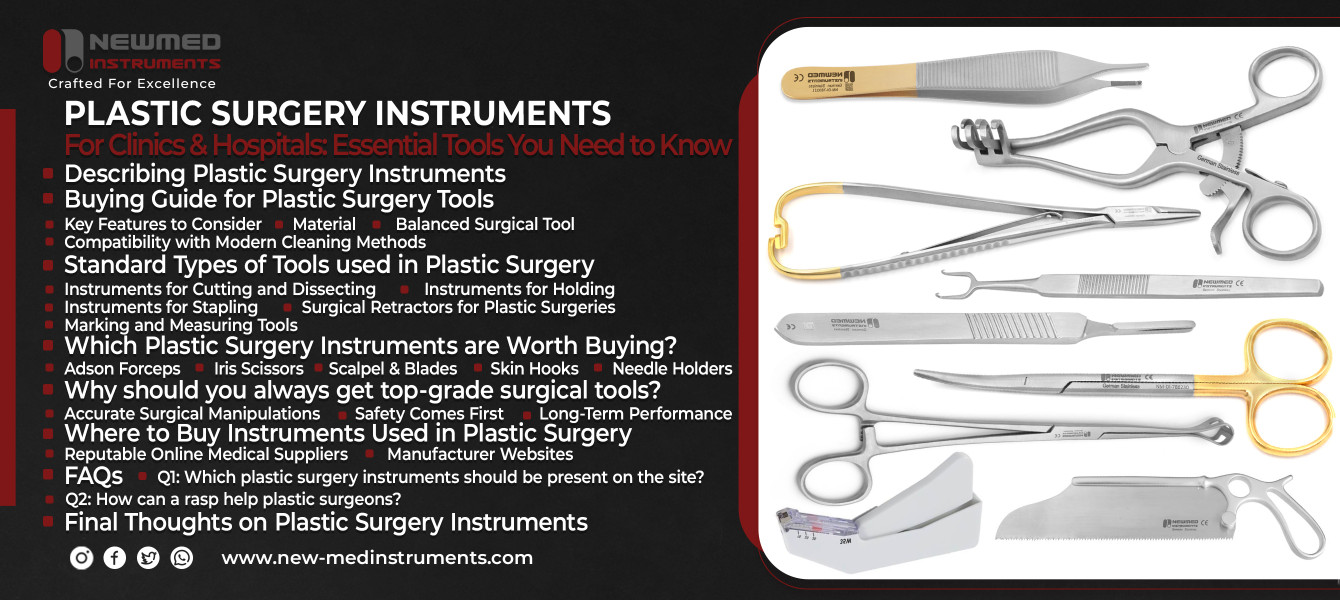
Plastic surgery instruments facilitate aestheticians and plastic surgeons to perform smooth cosmetic surgeries. Whether it is a high-profile reconstructive surgery or a procedure for skin grafting, our facility hands out surgical supplies to nearly every surgical domain within plastic surgery.
New Med Instruments has enabled the world of surgery with its remarkably strong tools for plastic surgery. No matter the configuration, surgeons can find any style or size they need.
In this New Med guide, we will elaborate on plastic surgery instruments required for clinics and hospitals. Further on, we will shed light on different types and styles of essential plastic surgery tools that you need to know. Continue reading to explore!
Describing Plastic Surgery Instruments
Tools used in plastic surgery help surgeons perform particular dissections, grafting, and aesthetic manipulations. For example, this surgical field includes dermatomes for grafting skin, retractors for breast surgery, microsurgical tools like forceps, and fine scissors, among others.
Buying Guide for Plastic Surgery Tools
Ordering surgical supplies online requires conscious decision-making. Therefore, we have prepared an in-depth buying guide for plastic surgery tools. In this way, you can analyse the long-term value and invest consciously.
Key Features to Consider
Here is a quick overview of the major features you should consider before getting your hands on plastic surgery tools. Precisely:
Material
The construction material of a surgical tool dictates its longevity. Surgeons prefer using High-grade German stainless steel. Moreover, recently, titanium has also been recommended for microsurgical tools. While tungsten carbide inserts are also finding use in modern instruments.
Balanced Surgical Tool
The tools used in plastic surgery should be well-balanced. This is only possible if the handles are ergonomically designed, that is, they have a non-slipping surface with proper configuration. Furthermore, make sure the supply store prepares their plastic surgery instruments with a matte finish. This helps reduce surgical glare and improves visibility.
Compatibility with Modern Cleaning Methods
Different sterilisation methods use different cleaning liquids. Therefore, make sure your team has made sure the construction material is compatible with all the modern cleaning methods.
Standard Types of Tools used in Plastic Surgery
To know the standard types of tools used in plastic surgery, read on:
Instruments for Cutting and Dissecting
During different plastic surgeries, surgeons use different cutting tools to cut eye tissues, skin folds, and facial muscles. Here’s a brief introduction of major cutting tools generally used during plastic surgeries:
Scalpels:
For cosmetic surgeries, practitioners require #3 handle with #10, #11, and #15. These scalpels help make precise incisions and surgical cuts, without causing any extra blood loss.
Scissors:
Mayo Scissors: Sometimes, during reconstructive surgeries, surgeons may come across tough tissues like fascia. During such a requirement, Mayo scissors are brought to the surgical field. Additionally, technicians may also use these to cut sutures.
Metzenbaum Scissors: Deep tissue dissection can be achieved with the help of these classic scissors.
Iris Scissors: Usually, folds around the eyes and facial tissues require precise cutting work. Hence, Iris scissors work best during such circumstances.
Electrosurgical Devices:
Monopolar/bipolar Insert: During aesthetic procedures, surgeons may need to close the blood vessels. At this, electrosurgical devices work wonders.
Instruments for Holding
Forceps:
Adson Forceps: Typically constructed with a fine alignment of toothed edges, adson forceps work great to hold multiple layers of skin during manipulation.
Russian Forceps: These modern holding tools work wonders while grasping dense tissue folds.
Hemostats:
Babcock Clamps: Mostly, plastic surgeons prefer Babcock clamps for precise holding and manipulation.
Crile Hemostat: Primarily, crile hemostats help close small blood vessels. Therefore, surgeons can find both straight and curved orientations in this category. The former is for superficial vessels, while curved for vessels located deep in the cavity.
Instruments for Stapling
Staplers:
In breast augmentation or tummy tuck procedures, the surgical incision is extensive. At such an important juncture, surgeons may use staplers. These ensure faster healing time with little to no post-op complications.
Needle Holders:
Mayo-Hegar Needle Holder: The classic method of closing the surgical wound is, of course, suturing. But during cosmetic procedures, the sutures should be very tactfully put in. Any showy or rough suturing can harm the overall look. Therefore, surgeons prefer using the Mayo-Hegar needle holder to drive the needle. This needle holder has been specially designed for this purpose.
Surgical Retractors for Plastic Surgeries
Senn Retractor: Typically, surgeons prefer using the Senn retractor due to its two working ends: a rake and a blade. While the rake hooks the skin, the blade helps push aside the surgical incision.
Skin Hooks: Primarily, technicians and surgeons use Gillies or Kleinert-Kutz hooks. These skin hooks aid in holding skin edges. However, the hooks are smooth enough. Therefore, they don’t harm the delicate skin folds.
Marking and Measuring Tools
Skin Markers: Pre-operative protocols require marking the calculated marks on the cosmetic surface. For this purpose, surgeons use skin markers.
Rulers: Typically, surgeons use measuring rulers with precise calibrations to measure skin flaps and cosmetic surfaces.
Calipers: During plastic surgery procedures like rhinoplasty and breast reduction, calipers help align the symmetry.
Which Plastic Surgery Instruments are Worth Buying?
Although every plastic surgery procedure has a specialised surgical kit with the necessary tools for smooth functioning. But some plastic surgery tools are needed almost in every surgical site, such as:
Adson Forceps
Generally speaking, plastic surgeons love having Adson forceps of 12cm length and 0.5mm to 0.9mm micro-tips. At times, when a higher grip is required, they prefer using Abdson-Brown forceps.
Iris Scissors
Iris SuperCut Scissors have been designed for fine dissection and precise cuts. They come with a microserrated blade. Moreover, the plastic surgery field deals with curved body contours. Therefore, only iris scissors can be used during such requirements.
Scalpel & Blades
This category of surgical cutters considers Swann-Morton Stainless Steel Handle No. 3 as absolutely perfect as a scalpel handle. Similarly, knowing about the blade number is equally crucial. Mostly, surgeons prefer blade#10 for general skin incisions. While for curved contours, blade#15 works wonders.
Skin Hooks
Flap elevation can be achieved with the help of either Double-Prong Skin Hooks or Gillies Skin Hooks. These skin hooks are every surgeon’s cherished possession.
Needle Holders
Usually, Olsen-Hegar or Mayo-Hegar needles have been thought of as the best needle drivers for suturing in plastic surgery.
Why should you always get top-grade surgical tools?
Here’s why buying top-graded surgical tools should be your priority:
Accurate Surgical Manipulations
A top-grade surgical instrument has perfect formation and accurate contours for the job. Furthermore, every function has a specialised instrument designated for it. Therefore, always consider surgical accuracy over the easy way out.
Safety Comes First
Getting your surgical supplies from a trusted online surgical supply store ensures excellence. Certified surgical instruments seldom deteriorate. Therefore, finding a certified supply store with a reputable standing can actually help level up your surgical game. Furthermore, high-grade tools lessen post-operative complications with their precise designs and top construction material.
Long-Term Performance
Buying surgical instruments can be costly. Usually, it is a notable purchase that should be made consciously. Good plastic surgery tools go a long way with you.
Where to Buy Instruments Used in Plastic Surgery
Reputable Online Medical Suppliers
Before purchasing, make sure the website you have landed on has good Google reviews with an overall reputable standing. Furthermore, every trustworthy store has its certifications displayed on its website. One should always fact-check before ordering.
Manufacturer Websites
See if the manufacturer’s website has a support page available. For example, New Med Instruments has a support page available 24/7. Their well-trained staff assists the customers at every step, whether it be shopping or delivery. Therefore, choose wisely.
FAQs
Q1: Which plastic surgery instruments should be present on the site?
Every procedure uses different surgical tools. However, some of the tools used in plastic surgery are at the heart of the field, such as microsurgical instruments, specialised surgical scissors, and elevators. Additionally, it is important to have specula, hooks, and measuring devices ready for use.
Q2: How can a rasp help plastic surgeons?
A rasp is essential to rhinoplasty. It helps file down and reduce nasal humps.
Final Thoughts on Plastic Surgery Instruments
Having high-grade plastic surgery tools at hand ensures you achieve the classic aesthetic results. Hence, investing consciously in top-grade surgical tools lets you enjoy a secure surgical field. At New Med Instruments, you can find highly efficient instruments used in plastic surgery at affordable prices. For orders, you can contact us now, either through landline or drop an email
Leave a Comment