
Plastic Surgery Tissue Forceps: A Surgeon’s Guide for Enhanced Cosmetic Results
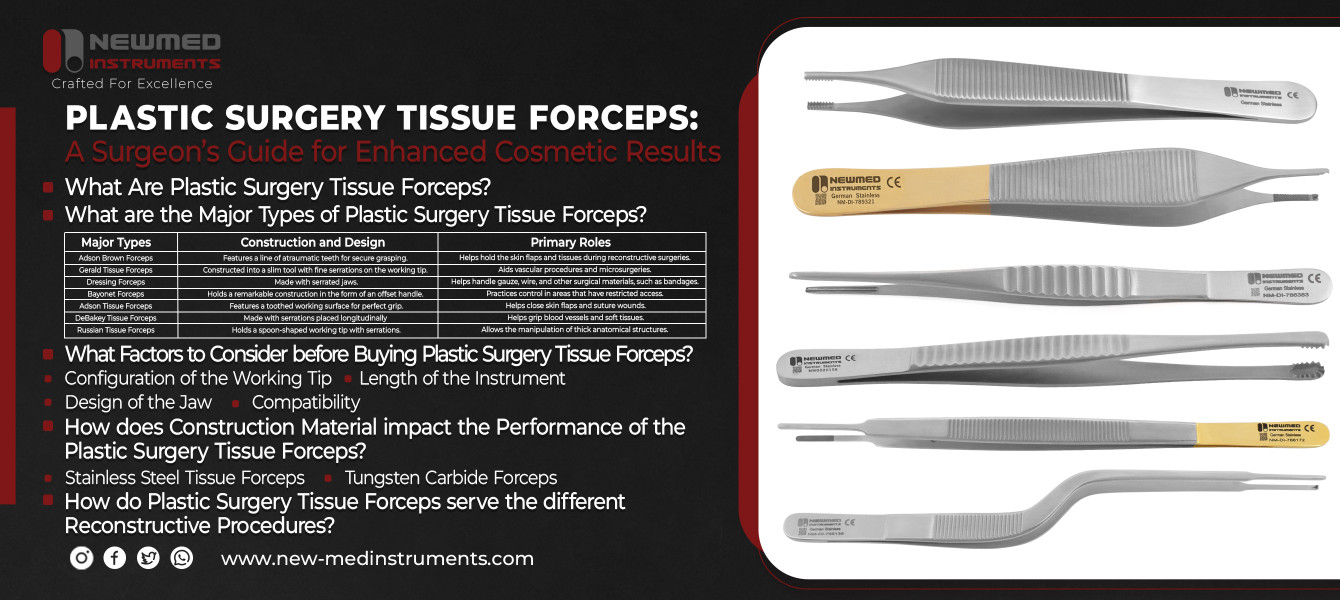
Plastic surgery tissue forceps are indispensable surgical tools for stabilising and retracting the delicate tissues during major reconstructive and cosmetic surgeries. Plastic surgery requires highly specific surgical instruments in different configurations and styles. Among these is a need for tools to hold and grasp. OEM Surgical Forceps Manufacturers fulfil this need by supplying specialised stainless steel tissue forceps.
This article is a surgeon’s guide on plastic surgery tissue forceps to assist healthcare professionals and surgeons with major types of tissue and dressing forceps, along with their uses, features, and core applications.
What Are Plastic Surgery Tissue Forceps?
Stainless Steel Tissue Forceps for plastic surgery are well-crafted surgical instruments featuring fine interlocking teeth and serrated handles. They have Tungsten Carbide inserts at the tips to increase the life of the tool. Functionally, they help surgeons manipulate different surgical structures, such as blood vessels, surgical material, and skin flaps, among others.
A range of plastic surgeries benefit from these tools, such as:
Breast reconstruction
Skin grafting
Scar revision
Blepharoplasty
Facelift procedures
Rhinoplasty
General soft tissue reconstruction
As plastic surgery mainly addresses the reconstructive issues of the delicate areas of the body, superior control can only be guaranteed with the help of tissue forceps.
What are the Major Types of Plastic Surgery Tissue Forceps?
Every distinct surgical procedure requires tissue forceps of different orientation. Orientation usually differs in tip configuration, jaw style, and holding mechanism. A quick review of the major types is given in the following table:
What Factors to Consider before Buying Plastic Surgery Tissue Forceps?
First and foremost, before choosing plastic surgery tissue forceps, surgeons consider the requirements of the particular procedure, the nature of the tissue they will handle, and the specific preferences of the surgical field.
Here’s a quick round-up of factors to consider before buying plastic surgery tissue forceps:
Configuration of the Working Tip
Broader Tips: Surgeons prefer this tip design when they are dealing with thicker anatomical structures and tissues.
Fine Tips: This tip configuration benefits cosmetic procedures where delicate structures must be held without harming the natural integrity.
Length of the Instrument
Short Handles: Surgeons use short plastic surgery tissue forceps when the manipulation is superficial.
Long Handles: This length provides access to the deep cavities and surgical sites.
Design of the Jaw
Toothed jaws: Tissue forceps with toothed jaws provide a secure grip.
Smooth jaws: Mostly, surgeons use tissue forceps with smooth jaws for soft tissues.
Serrated jaws: In case of highly sensitive tissues, forceps with serrated jaws are used.
Compatibility
Presently, Plastic Surgery Forceps Suppliers use high-grade surgical stainless steel with Tungsten Carbide inserts. These materials do not corrode despite repeated cleaning cycles.
How does Construction Material impact the Performance of the Plastic Surgery Tissue Forceps?
Ultimately, the performance of a surgery depends a great deal on the material of the instruments used. Plastic surgery tissue forceps mainly use two different construction materials that endow them with specific qualities. Let’s discuss this in detail:
Stainless Steel Tissue Forceps
Plastic surgery tissue forceps made with high-grade surgical stainless steel provide the following advantages:
Increased mechanical strength
Protection against water damage and corrosion
Tool surface is well-finished
Lasts long and cuts down management costs
Keeps the jaw alignment in order
Tungsten Carbide Forceps
During plastic surgeries that require superior control, surgeons turn to tungsten carbide forceps for the following qualities:
Holds exemplary jaw retention and edge configuration.
Allows superior grip over the tissue
Works well in high-volume surgical settings
How do Plastic Surgery Tissue Forceps serve the different Reconstructive Procedures?
Throughout the different stages of plastic surgery, surgeons heavily rely on tissue and dressing forceps. Their applications include:
Grasping the soft and thick tissues
Approximating the tissue
Closing the surgical wound
Grafting the skin flaps
Achieving hemostasis
Stabilising the tissues
FAQs
Q1: What are the specified functions of smooth vs. toothed tissue forceps?
The major difference between the smooth and the toothed tissue forceps lies in their functions. The former allows surgeons to grasp vessels and soft tissues. While the latter enables professionals to manipulate the thicker anatomical structures securely.
Q2: How is the bioburden removed from the plastic surgery tissue forceps?
Technicians use certified protocols to remove the bioburden from the tissue forceps. First, the instrument is rinsed and inspected for any faulty alignment. Once that is cleared, the tool is sterilised through autoclaving.
Q3: Can dressing forceps be used again and again?
Yes. Dressing forceps can be used again and again. However, it is important to follow the prescribed method of cleaning in letter and spirit. Furthermore, routine checks for alignment and jaw management are important.
Q4: Can we use standard tissue forceps for plastic surgery?
No, standard tissue forceps can’t be used for plastic surgery. Plastic surgery requires short-handled and fine-tipped tissue forceps for manipulation. These tissue forceps are specialised to grip fascia, skin flaps, and soft tissues without harming the integrity.
Q5: What should I do if I suspect jaw disalignment?
If you suspect jaw disalignment in your plastic surgery tissue forceps, contact your tissue forceps manufacturer. Report the issue and check the company’s policy. Most manufacturers provide realignment facilities at reasonable costs. If the fault lies during the manufacturing process, the tools can be replaced.
Buy Tissue Forceps Online
Having a reliable and CE-certified surgical forceps goes a long way in ensuring 100% surgical outcomes. Depending on the surgeon’s preferences and the needs of the surgical field, plastic surgery tissue forceps can be ordered online. If you are a healthcare facility working at an extensive level, wholesale tissue forceps can be obtained.
New Med Instruments is a well-reputed surgical instrument exporter and a plastic surgery forceps supplier. In case of orders and bookings, you can contact us now. We offer an extensive range of FDA-approved stainless steel tissue forceps and tungsten carbide forceps to ease your surgical practice.